
Agility in risk management: data, stakeholder engagement, and lessons from the field
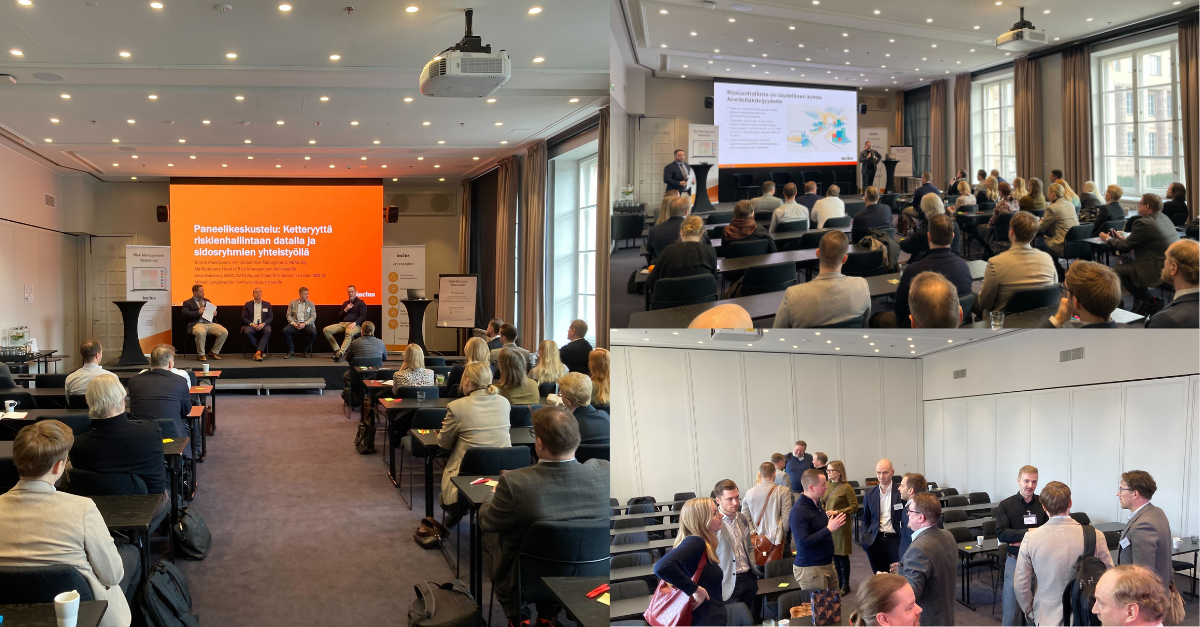
On March 10 2026, risk management professionals met at Scandic Grand Central Helsinki for an Inclus breakfast event. Over a panel discussion and coffee, they shared practical experiences and compared notes on where risk management is heading.
The panel discussion, titled "Agility in risk management with data and stakeholder collaboration", brought together three practitioners from different organisational contexts: Tommi Paavilainen, VP of Global Risk Management at KONE; Aki Rantanen, Head of Risk Management at Veikkaus; and Vesa Hakanen, EMEA Supply Chain Risk Solution Leader at AON. The conversation was moderated by Mikaeli Langinvainio, CEO of Inclus.
Before the panel, Juha Törmänen, CTO and Co-founder of Inclus, gave a short presentation on what to expect from AI in risk management during 2026, both in the field generally and in the Inclus product specifically.
AI in risk management: the direction of travel
Juha Törmänen outlined his view of where AI is heading for risk professionals. The longer-term concept is what we call the Digital Risk Office — an environment where risks are continuously monitored and surfaced for decision-makers with AI support.
A more immediate version of this is already in use at Inclus: an AI agent that acts as a risk secretary, helping to flag, summarise, and prompt follow-up.
The AI thread continued throughout the morning, with panelists touching on how data tools are changing what is possible — while also noting that technology alone does not resolve the human and organisational side of risk management.
Three organisations, three approaches
A useful feature of the panel was the variety of use cases it represented.
Vesa Hakanen focused on supply chain risk. He described the challenge of maintaining visibility across networks of both digital and physical suppliers, and how allowing sites to cross-reference each other's data creates a more transparent picture across the organisation.
Aon works with companies that have hundreds of users in their risk platforms, and getting that shared view right is a practical prerequisite for useful analysis.
Aki Rantanen from Veikkaus spoke about risk appetite as a management tool. At Veikkaus, a clear definition of acceptable risk levels, set from the top, helps connect board-level decisions to day-to-day operations.
Data-driven tools play a role here in making that connection visible and consistent across the business.
Tommi Paavilainen's points were largely about adoption. Getting an organisation to actually engage with risk management and not just install a system requires deliberate effort.
KONE had run an internal road show when rolling out Inclus, sending people to demonstrate the tool directly rather than relying on self-service adoption. The approach paid off in terms of commitment and understanding across the organisation.
"Not everything needs to be digital. If you have the time and resources to show people hands-on how something works, that tends to build commitment in a way that remote rollouts often don't."
It is a practical point that applies across industries: the uptake of any risk management initiative is partly a people question, not just a tool question.
Stakeholder engagement as a core part of the process
Stakeholder engagement came up repeatedly across the panel. Getting leadership buy-in, building wider organisational involvement, and making sure risk assessments reflect multiple perspectives — including cross-functional impact views — were all discussed as things that matter as much as the technical setup.
There was also a more personal dimension to this. Risk management asks people to think carefully about things that are uncertain and sometimes uncomfortable. When that thinking happens collaboratively, with colleagues, with peers from other organisations, it tends to go better.
Shared context helps, and so does knowing that others are working through similar questions.
Shared challenges across different sectors
One observation that came up more than once was that despite the differences between the organisations in the room; a global elevator company, a state-owned gaming operator, an insurance company; many of the underlying challenges are quite similar.
Supply chain visibility, leadership alignment, data quality, keeping pace with change: these are common concerns regardless of sector.
That kind of cross-sector peer exchange is part of what Inclus aims to facilitate through these events.
After the formal program wrapped up, participants stayed on for another hour of informal conversation — a reasonable indication that there was more to discuss.
Takeaways
Agility in risk management involves both technical and organisational elements.
On the technical side, having good data, real-time visibility, and tools that allow cross-referencing makes a real difference.
On the organisational side, leadership engagement, clear communication, and deliberate adoption efforts are just as important.
The panel did not offer a single formula; the three organisations represented had taken quite different paths.
But they had arrived at broadly compatible conclusions about what matters: good data, engaged stakeholders, and enough organisational buy-in to make the work stick.