
Peace through technology – Inclus at the Ministry for Foreign Affairs' press event
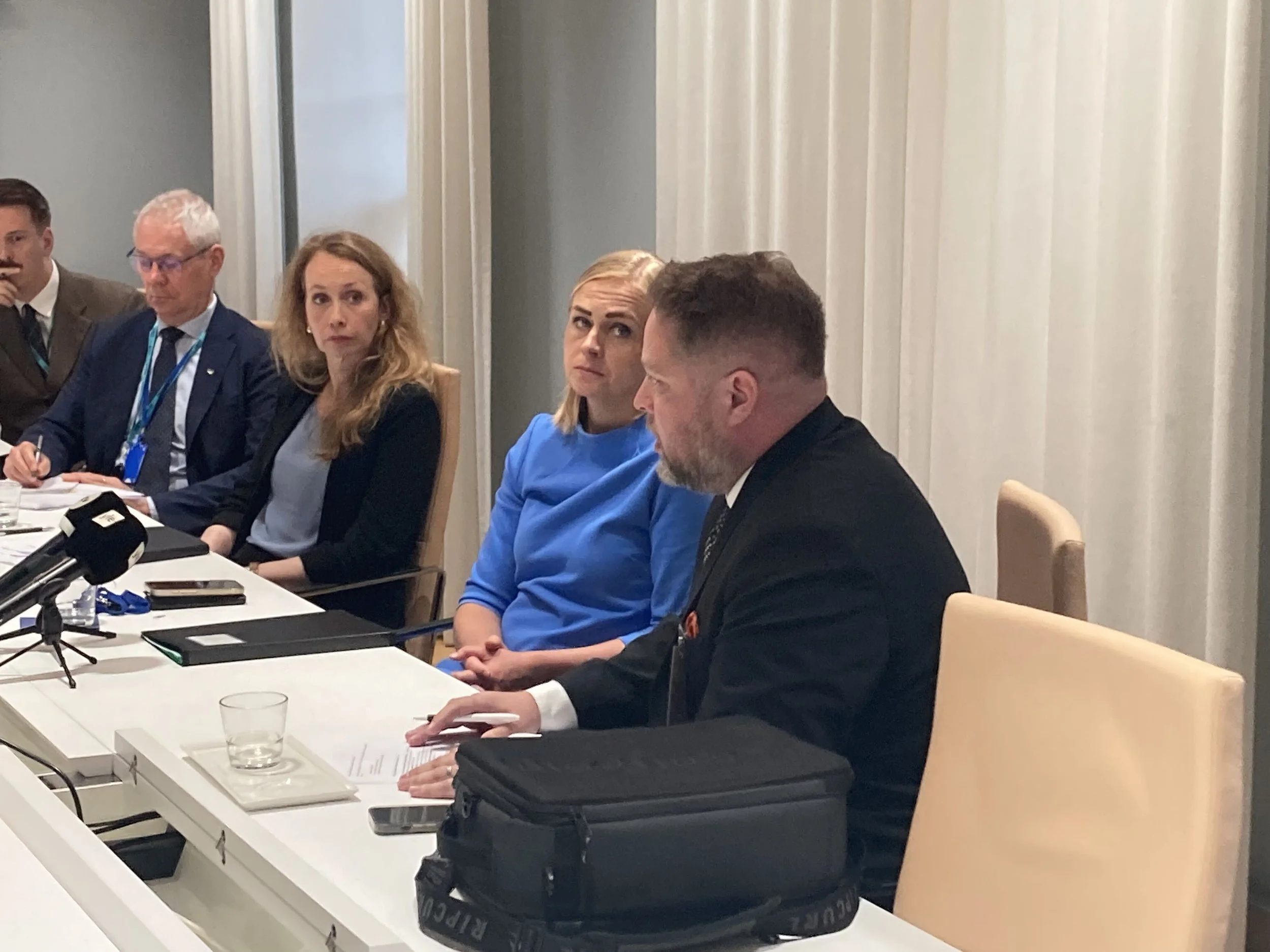
On 17 June 2026, Inclus was invited by the Finnish Ministry for Foreign Affairs to a press event titled "A Trusted Partner for Peace". Together with Foreign Minister Elina Valtonen and CMI's Johanna Poutanen, Inclus' CEO Mikaeli Langinvainio took the floor to speak about the potential of peace technology. Here are some reflections on the event.
The world needs peace technology to balance the war economy
The day opened with a sharp question: where is the same innovation energy and appetite for investment in peace technology that today flows so freely into military technology? AI is currently being used widely for targeting, surveillance, and disinformation. But the same technology also enables the ability to hear and understand larger groups of people more deeply than ever before.
AI is not just an evolution. It is a revolution. And it draws from the entire history of humanity and the written word. It belongs to all of us.
Who we are
Inclus is a participatory risk management software company. Our motto is simple but ambitious: Building common understanding with technology.
Inclus did not emerge from nothing. It was born as a spin-off from CMI. In 2011, President Martti Ahtisaari asked for a methods and tools team to be built within CMI to develop new approaches to peace mediation. That team grew into an independent company in 2016. Without CMI, there would be no Inclus.
Over the years, we have been involved in approximately 25 peace processes, and counting.
What peace technology means to us
Inclus defines PeaceTech precisely: technology that conflict parties themselves use to prevent and resolve conflicts. Technology does not resolve conflicts - people do. But technology can make a genuine difference in three specific areas:
Anticipation and prevention: identifying tensions before they escalate
Supporting dialogue and mediation: facilitating both intra-party and inter-party dialogue
Implementation of agreements and trust monitoring: making sure what is agreed is actually delivered
At the heart of our mission is a simple idea: when people understand complex issues better together, they also understand each other better. This has never been more important in a world defined by deepening dividing lines both within societies and between them.
AI enables an unprecedented scale
One of the most significant observations of the event was about scale. The ability to collect, process, and analyze data is advancing at a remarkable pace. We are approaching a point where we can facilitate technology-assisted dialogues involving a million people. This means that peace processes no longer need to be confined to small elite groups negotiating on behalf of everyone else, but broad populations can be genuinely and scalably included.
As CMI's Johanna Poutanen aptly noted at the event: in rapid top-level crisis settlements, there is always a risk that large populations do not feel heard, and a peace that people do not feel ownership of is unlikely to last. Technology can offer real solutions to this problem.
The role of the private sector in peace work
Foreign Minister Elina Valtonen emphasised at the event that technology can be used in building and sustaining peace. But what added value can a private company like Inclus actually bring?
One key thing is a sustainable funding model. We are not dependent on project grants but have recurring licences and long-term investors who are motivated by a genuine commitment to peace, not just returns. This enables the kind of long-term development work that one-off projects simply cannot sustain.
At the same time, one thing must be said clearly: peace mediation must be free of charge. Charging the parties involved risks undermining the trust that the entire process depends on. That is why public actors need to be involved in providing support. Peace mediation cannot be purely commercial. In our model, vetted partners can use the technology on a pro bono basis.
Other strengths the private sector brings to peace work include technological agility, scalability, and commercial expertise in areas such as information security, user experience, and technical delivery.
Lasting peace is built locally
One of the most important messages of the event was that technology must not replace local actors; its role is to strengthen their capacity. Technology is not an end in itself. It is a tool. Our field experience from for instance Armenia, Yemen, and Ukraine confirms this: technology works when it serves local needs in local hands.
Ukraine is a particularly striking example: through a Finnpartnership-funded project, we have supported the capacity of Ukrainian local actors during the conflict, not waiting until the reconstruction phase.
An invitation: Finland can lead in peace technology
Finland is in a unique position: we have both peace mediation expertise and technology expertise. We warmly encourage companies and startups from all sectors to get involved in peace work. Commercial technology can be applied to peaceful purposes: this is about civilian-peace use, not civilian-military use.
AI is amplifying the war economy. It is time to build a peace economy alongside it.
Inclus is a participatory risk management software company that has been involved in over 25 peace processes since 2012. The company was founded as a spin-off from CMI, continuing the legacy of President Ahtisaari, and is based at Aalto University's campus in Espoo.