
Rethinking peace: Reflections from CMI's 25th Anniversary Conference
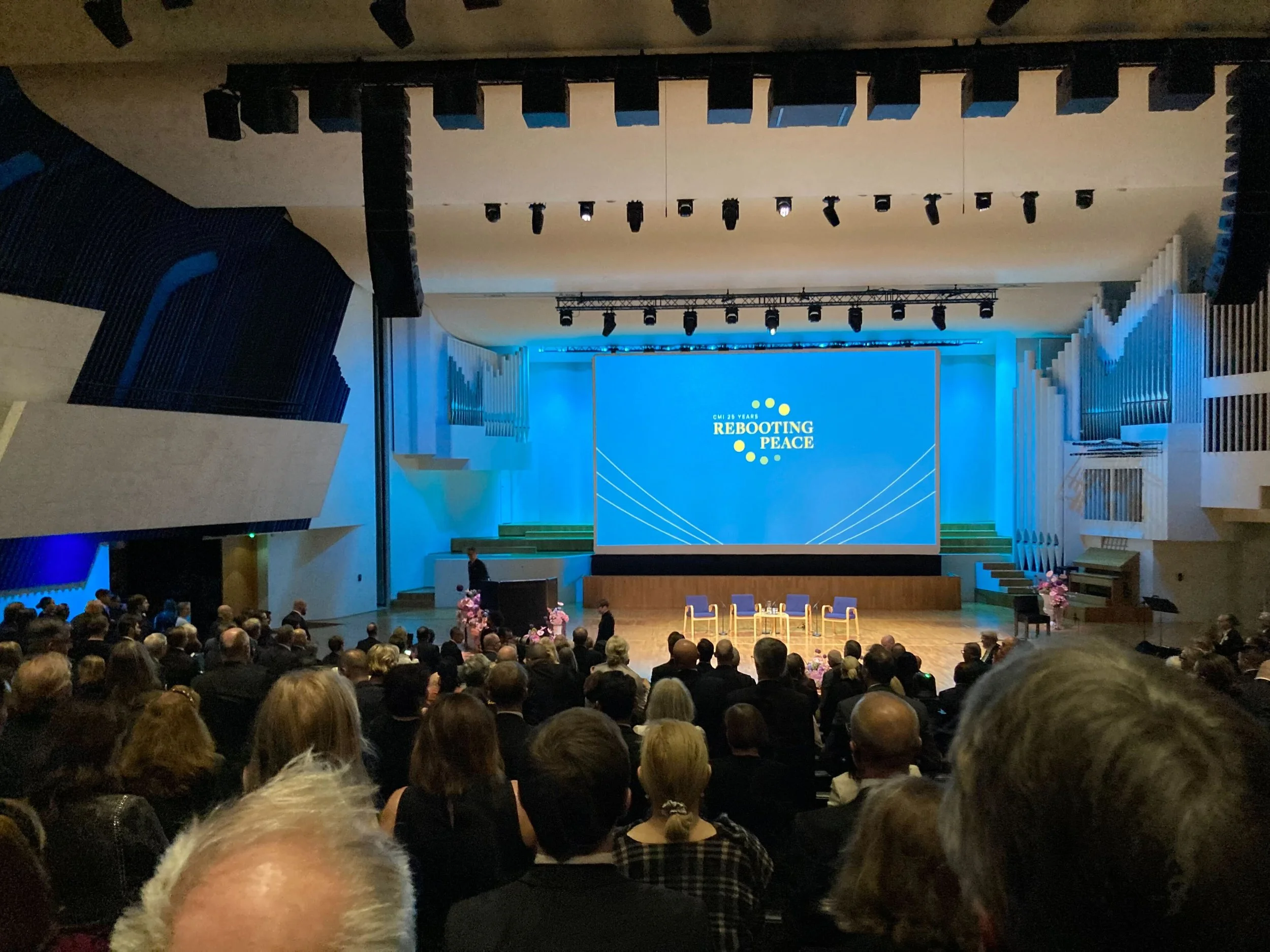
On Dec 3,2025, the Inclus team had the privilege of attending CMI's 25th anniversary conference at the Finlandia Hall in Helsinki, a milestone celebration that felt quite personal to us.
Inclus' connection to CMI runs deep: Inclus was spun off from the organization, and our founders spent years working alongside CMI's peacemaking practitioners. Returning to celebrate this quarter-century milestone felt like coming home, especially as ‘inclusivity’ (along with ‘transparency’, ‘collaboration’,and ‘trust’) in any peacemaking efforts really is the key thing and it was indeed repeated frequently in the event.
A legacy of innovation in peacemaking
The conference, titled "Rebooting Peace," brought together an extraordinary assembly of voices from the intersection of technology, peace, and international relations. The daytime program focused on "CMI x Finnish Tech: How Technology Can Support Peacemaking Efforts" — a fitting theme for an organization that has consistently positioned itself at the forefront of integrating technological innovation with traditional peacemaking approaches.
The program featured remarkable speakers including:
Angela Oduor Lungati, Executive Director of Ushahidi
Adam Schumacher, Program Director for Talk to the City at the AI Objectives Institute
Mikko Hyppönen, Chief Research Officer at Sensofusion
Miapetra Kumpula-Natri, Member of the Parliament of Finland
Veera Heinonen, Director of Foresight and Training at Sitra
Marko Ahtisaari, Chief Marketing Officer at ICEYE
Martin Wählisch, Professor of Transformative Technology, Innovation, and Global Affairs at the University of Birmingham
The conversations explored critical questions:
What happens when algorithms meet the complexity of human conflict?
How can AI enhance early-warning systems?
How can digital platforms surface citizen perspectives at scale in fragile contexts?
These aren't abstract discussions, they're about real applications that can help societies anticipate risks, understand evolving dynamics, and support more informed responses.
An evening of reflection and vision
The evening program began with a beautiful musical interlude — excerpts from J.S. Bach's Solo Cello Suite No. 1 in G major, performed by saxophonist Jukka Perko and cellist Beata Antikainen.
After opening remarks from Dr. Janne Taalas (CEO of CMI) and Ms. Hanna Klinge (Deputy CEO), President Alexander Stubb took the stage for his opening reflections, moderated by Katri Makkonen, Senior Advisor and Founding Partner at M.Soc.Sc.
President Stubb's connection to CMI, having worked with the organization earlier in his career, added a layer of authenticity to his remarks. His presence underscored CMI's evolution from its founding in 2000 by Nobel Peace Laureate and former President Martti Ahtisaari to its current standing as a leader in international peacemaking with over 100 international experts and 300 global partners.
The evening continued with remarks from H.R.H Prince El Hassan bin Talal of Jordan, followed by H.E. Mary Robinson, Former President of Ireland, former UN High Commissioner for Human Rights, and member of The Elders.
Each speaker brought decades of experience in peace, human rights, and international diplomacy to bear on the question of how peacemaking must evolve in our fragmented global order.
The high-level exchange
The centerpiece of the evening was a high-level exchange titled "The future of peace mediation in a fragmented global order," moderated by Dr. Janne Taalas. The panel brought together three remarkable women leaders:
H.E. Mary Robinson - Former President of Ireland, former UN High Commissioner for Human Rights, member of The Elders
H.E. Ambassador Liberata Mulamula - Special Envoy of the Chairperson of the African Union Commission on Women, Peace and Security, former Foreign Minister of Tanzania
Ms. Fawzia Koofi - First Woman Deputy Speaker of the Afghan Parliament, President of Women for Afghanistan
This was a conversation among women who have spent their lives in the trenches of peacebuilding, each bringing unique perspectives from different regions and contexts.
Redefining peace?
While the day was filled with thought-provoking discussions, one moment stood out and will stay with us for a long time. Fawzia Koofi, President of Women for Afghanistan and the first woman Deputy Speaker of the Afghan Parliament, challenged the entire room to reconsider what we mean when we talk about "peace."
As an example: Is Afghanistan at peace?
Technically, one might say yes, the gunfire has stopped. But as Koofi articulated, for the past four years, women and girls in Afghanistan have been prohibited from owning something as simple as a pencil or a piece of paper. They live in apartments where windows must remain constantly curtained, their very existence confined and controlled.
What kind of peace is that?
Her question hung in the air, forcing us all to confront an uncomfortable truth: the absence of violence is not the same as the presence of peace.
True peace isn't just the silence of guns — it's the freedom to learn, to participate, to exist fully in society. It's about dignity, agency, and the fundamental rights that allow human beings to flourish.
Why this matters
Koofi's intervention reminded everyone in the room that peace mediation and conflict resolution cannot simply aim for the cessation of hostilities. The work of organizations like CMI, and by extension, companies like Inclus that have emerged from that ecosystem, must consider what comes after the fighting stops.
Technology can help us monitor conflicts, predict escalations, and facilitate dialogue. But it must also help us build the kind of peace where a young Afghan girl can own a pencil without fear.
A call to action
The evening concluded with remarks from Ms. Kaisa Raitio, Head of Communications and Private Fundraising at CMI, before Marko Ahtisaari, Chair of the Board of CMI (and son of founder Martti Ahtisaari), delivered closing reflections.
His words brought the evening full circle, honoring his father's legacy while challenging everyone present to continue pushing the boundaries of what peace mediation can achieve in an increasingly complex world.
Inclus was spun off from CMI in 2016, building on years of expertise in dialogue facilitation, conflict resolution, and inclusive peacemaking. While primarily working on corporate risk management these days, Inclus continues to support complex collaboration processes in the areas of peace and conflict resolution around the world.